Security quality model for Electronic Health Records

Electronic Health Records (EHRs) are real-time, patient-centered records that instantly and securely make information available to authorized users. The information contained in EHRs is sensitive since, in general, it consists of the patient’s medical history (hospitalizations, treatments, illnesses, among others).

One of the most relevant aspects of EHRs is security. More specifically, Confidentiality and Privacy are critical attributes for security in EHRs. In this regard, assessing the security of EHRs (and systems, in general) is too complex. Security can be characterized from institutional policies to sophisticated attacks on software and critical infrastructure. Therefore, to help reduce this complexity, we are working on a quality model to evaluate the current state of EHR security to support security decision-making in software vendors and clinical facilities. The first version of this quality model was evaluated with 20 professionals from the Chilean healthcare industry.

Screen Shot 2020-05-21 at 10.49.29 PM

We are improving the model and, at the same time, developing a platform that will allow us to automate this evaluation.
Frameworks, platforms, and microservices

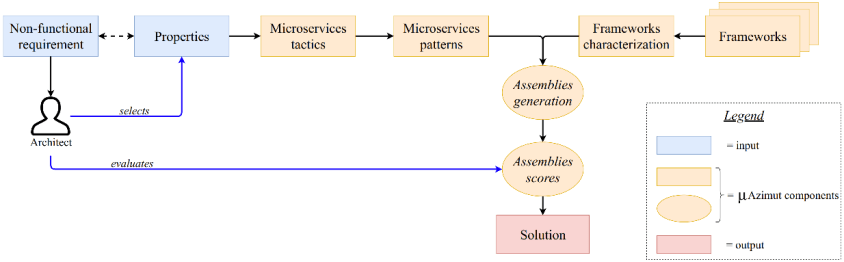
In the development of microservices-based systems, one of the typical questions that software developers ask is: Which technologies (such as frameworks and platforms) do I have to select to develop the microservices project? The market for frameworks and platforms to develop not only microservices-based systems but also all kinds of systems is too broad. So, What criteria should be used to select technologies? One “obvious” criterion is “the technology that is cheaper and takes less time”. But, this criterion is one of many that an architect should consider when developing a microservices-based system.

To help with this complex task, we have created a technique that allows evaluating sets of frameworks and platforms based on quality attributes.

Screen Shot 2020-05-21 at 10.07.54 PM

This tool helps the software architect reduce the space of technological solutions in the market into a more specific set that allows her or him to satisfy the main non-functional requirements of a microservices project. To evaluate the technique, we used it in an industrial project, obtaining promising results.

Security and Telehealth System

Software Engineering can be applied in several fields, such as health. In this regard, there are many challenges that some health systems, such as Telehealth systems, promote in software development. Having said that, we investigated how Software Engineering helps to develop secure Telehealth systems. The findings of our research suggest that sophisticated requirements elicitation and the correct definition of software architectures are essential to satisfy security.

This work was published in IEEE Access.

Experts or novices in the software architectural design decision-making? An experimental study

Software engineering literature describes several decision-making techniques for architectural design. However, the impact of the experience of those who use these techniques on their efficacy has been little explored.

We experimented with 24 IT practitioners in order to evaluate the impact of the experience of software architecture decision-making team members on the efficacy of TaSPeR (Tactics Selection Poker), a technique that supports architectural design decisions (inspired in the Planning Poker technique).

This research, led by Juan P. Brito, reveal that for teams with more experienced members the use of TaSPeR turned out to be harmful for the selection of software architecture tactics, in contrast to the more experienced teams, for which the use of TaSPeR was quite beneficial. Other key findings are discussed in the article.

This article was accepted in the International Conference of the Chilean Computer Science Society (SCCC).

Migration from monolithic to microservices, What has been done so far?

Microservices architecture has become enormously popular because traditional monolithic architectures no longer meet the needs of scalability and rapid development cycle, and the success of some large companies in building and deploying services is a strong motivation for others to consider making the change.

However, performing the migration process is not trivial. Most systems acquire too many dependencies between their modules, and thus can’t be sensibly broken apart. It is for this reason that studies that provide information associated with the migration process to practitioners are necessary.

We have performed a rapid review to analyze the current state of the migration of monolith systems to microservices. In this investigation, led by Francisco Ponce, we discuss some key findings related to:

What techniques are used to migrate monolith systems to microservices?

What happens to databases during migration?

This article was accepted in the International Conference of the Chilean Computer Science Society (SCCC).

Security, availability, ​and microservices-based systems

There is no doubt that security is a constant concern for organizations. Furthermore, if these organizations use microservice architectures in their systems, security becomes an ongoing concern. To address security concerns, three critical quality attributes must be analyzed, which are integrity, confidentiality, and availability. Regarding this last one quality attribute, we conducted an empirical study where we identified design decisions (better known as architectural tactics) for availability with the aim of supporting security designs in microservices architectures (see the below Table).

tactics.png

This study will be presented in the 1st workshop on Designing and Measuring CyberSecurity in Software Architectures (DeMeSSA), held by the European Conference on Software Architecture (ECSA).

Security Mechanisms Used in Microservices-Based Systems

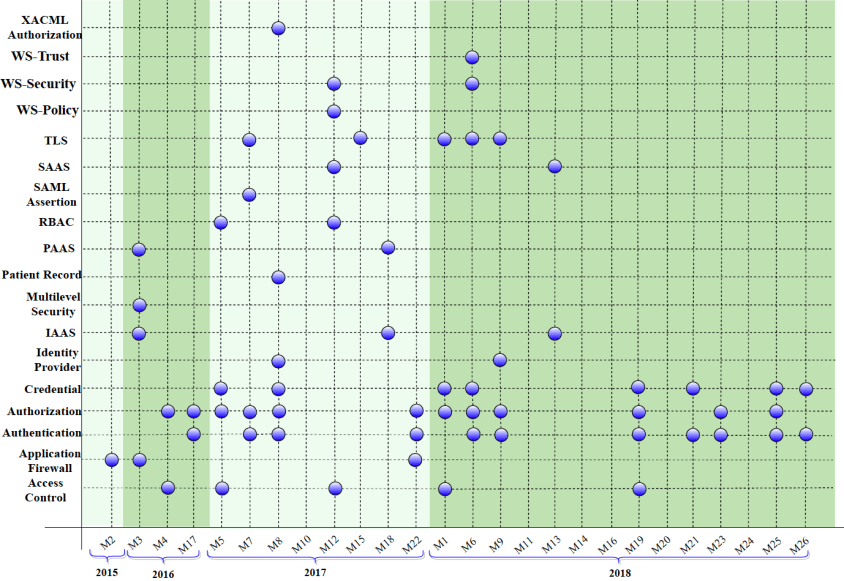
Microservices is an emerging architectural style that is being used by the industry. This style provides several advantages, but at the same time, challenges. One of the critical challenges is security. In order to understand the current scene regarding security, we performed a systematic literature mapping to illustrate the security mechanisms used in microservices-based applications. In summary: many proposals detect and/or mitigate attacks. However, there are very few proposals that react to attacks and, on the other hand, we do not find proposals to recover from attacks. The figure describes the mechanisms currently used (Y-axis) and the primary studies (letter “M”) sorted by year (X-axis).


Screen Shot 2019-06-20 at 11.41.34 PM.png

This article was accepted in XLV Latin American Computing Conference (CLEI 2019).

Architectural Technical Debt and Microservices-based Systems

Today, the microservices architectural style is an emerging trend in the industry. In order to develop microservices-based systems, architectural decisions are the first and fundamental steps to address quality goals. In this article, we described preliminary research about a content-based recommender system (CBRS) composed by microservices architecture patterns and architectural tactics as a basis for obtaining a recommendation of architectural decisions in microservices architectures to make more robust decisions to manage architectural technical debt.

Screen Shot 2019-05-08 at 12.26.13 PM.png

Scalability and Microservices-based Systems

Recently, we conducted an empirical study on open microservices-based systems and scalability. We used our pattern language in order to explore which frameworks (commonly used to develop microservices architectures) address the scalability dimensions. Results show that (1) 9 common frameworks satisfy the scalability dimensions (see the following figure, x-axis: frameworks, y-axis: microservices patterns); (2) frameworks produce trade-offs among scalability dimensions; and (3) few frameworks address several scalability dimensions at once. Finally, we identify five reusable design decisions to address scalability requirements and propose them as microservices architectural tactics.

Screen Shot 2019-05-07 at 11.06.40 PM.png

This study was presented at the 37th International Conference of the Chilean Computer Science Society (SCCC), 2018.

Exploring Security Issues in Telehealth Systems

Telehealth systems (TS’s) provide remote health-based services to improve the quality of service of patient treatment. Most healthcare professionals have access to standard telecommunications technology (such as Wireless Body Area Network (WBAN), biosensors, remote medical robots, and others) to offer remote care of elderly and physically less able patients as well as remote surgeries, treatments, and diagnoses. In order to ensure the functionality of TS’s, several systemic properties must be satisfied, including security. Although there are studies that discuss different security approaches in TS’s, it is difficult to have a clear view of existing security issues and solutions for these systems.

We conducted a review to detect, organize and characterize security issues in TS’s in order to discuss challenges (emerged from these issues) from Software Engineering point of view. In summary, we identified 5 attacks, 4 vulnerabilities, 2 threats, and 1 weakness commonly reported in TS’s. Also, we described solutions (reported in academia) to face these security issues plus other qualitative results.

Finally, in the following figure, we illustrate the evolution of security issues according to years and TS’s contexts.

Screen Shot 2019-03-08 at 12.17.27 AM.png

Letters “I” (Integration), “P” (Privacy), “D” (Insecure data transmission), “T” (Trust), “IO” (Interoperability), “M” (Risk Management), and “R” (Requirements) indicates target problems. Composed letters (e.g., I-T) indicate more than one target problem.

Finally, our paper was accepted in the 1st International Workshop on Software Engineering for Healthcare (SEH) (in conjunction with ICSE 2019).