
Month: October 2025

Exploring Security Controls in Health Information Systems Using CodeBERT

Health information systems (HISs) are integral in enhancing clinical operations and improving patient care. To fulfill this role, these systems require a comprehensive design capable of addressing essential health quality attributes such as security. This design, typically embodied in software architecture, must incorporate secure design decisions that adhere to established software security policies and guidelines. Such design decisions are frequently represented by security control (also known as security tactics). Despite the significance of implementing and developing security control to protect information within HISs, there is a paucity of empirical studies that examine which security control are actually used in these systems. This gap significantly hinders the reuse and acceleration of secure design decisions within the software architecture of a system. In this paper, we report a study aimed at identifying security controls in health software projects by utilizing a CodeBERT model. We applied the trained model to 10 open-source projects related to HISs, and classified the identified security tactics.
The findings suggest that the security controls identified in HISs predominantly focus on security-by-design prevention strategies, whereas detection and recovery strategies remain largely unaddressed in the context of attacks. Our study represents an initial effort to elucidate which secure design decisions are prioritized in the development of HISs.

This research will be presented in International Conference of the Chilean Computer Science Society (SCCC)
Exploring Machine Learning and Explainable Artificial Intelligence Models to Identify Potential Hidden Risk Factors in Breast Cancer Data

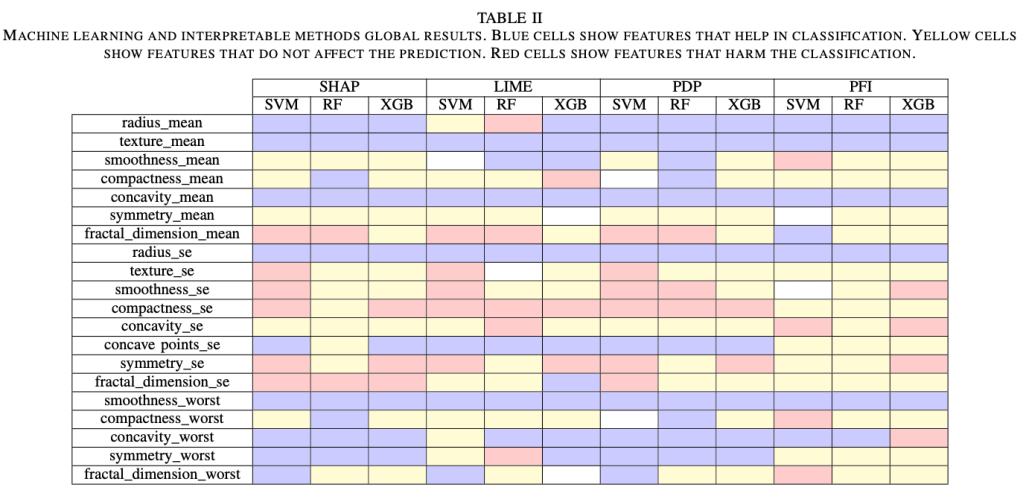
Hidden risk factors in cancer are elements that contribute to the development or progression of cancer but are not immediately apparent or easily detectable. These factors may encompass genetic alterations, environmental exposure to carcinogens, and socio-demographic variables. Although early detection strategies exist to identify hidden risk factors at more treatable stages of cancer, there is limited discussion on the application of artificial intelligence models to support the identification of these hidden risk factors. This paper presents a study focused on the identification of potential hidden risk factors in cancer through the use of machine learning and explainable artificial intelligence techniques.
We analyzed a breast cancer database and employed support vector machine, random forest, and extreme gradient boosting to classify the data. Subsequently, we utilized four explainable artificial intelligence techniques to examine the positive, neutral, and negative features of the dataset. The findings of our study suggest that explainable artificial intelligence facilitates the identification of positive features within the dataset that are considered potential hidden risk factors for breast cancer.
These results can significantly contribute to the enhancement and support of cancer-screening strategies.

This research will be presented in International Conference of the Chilean Computer Science Society (SCCC)

Machine Learning Techniques in Microservices: A Systematic Mapping

Microservices architectural design has become increasingly popular due to the enhanced scalability, flexibility, and maintainability of large and complex applications. Machine learning (ML) has emerged as a powerful tool in microservices deployment and management. Although ML techniques have been useful for building microservices-based system architectures, the current literature does not provide clear guidance on which ML techniques developers of these systems might use. This research describes the design and results of a systematic mapping study to identify the ML techniques used in the building of microservices-based systems. The review yielded 193 articles, of which 34 primary studies were selected. Key findings are: (i) Monitoring, diagnostics and observability (MDO) and Resource orchestration and management (ROM) are the most used domains; (ii) Deep Learning (DL) and Unsupervised Learning (UL) are the most used techniques; (iii) Proposed solutions validated through evaluative research dominate the field; (iv) Case studies and experiments are the main empirical strategies; and (v) Public data sets are limited. This effort will enable developers to effectively address the refinement and improvement of software designs using ML methods.

This research will be presented in International Conference of the Chilean Computer Science Society (SCCC)

Learning and Predicting Competitive Tumor-Immune-Normal Cell Dynamics Using Physics-Informed Neural Networks

Modeling tumor progression and immune response is a key challenge in computational oncology. Traditional ODE-based models offer insights into interactions among cancerous, healthy, and immune cells, but often rely on ideal assumptions and dense data. In this research we explored the use of Physics-Informed Neural Networks (PINNs) to learn and predict the behavior of a nonlinear system modeling tumor-immune-normal dynamics. By embedding biological equations into the learning process, PINNs can train on sparse or noisy data while respecting domain constraints. We assess their performance under varying data availability, showing that moderate training data enables accurate reconstruction and extrapolation, whereas excessive data may induce localized errors. These findings suggest that PINNs are promising tools for biomedical modeling, with potential applications in personalized simulation and treatment planning.

This research will be presented in International Conference of the Chilean Computer Science Society (SCCC)