Month: July 2025

Security Discussions in Quantum Software Projects on GitHub

Quantum software engineering is an emerging field that leverages quantum computing and software development to address contemporary computational challenges. A significant concern in this domain is security, which has become a critical issue in quantum software engineering. Despite advances in quantum computing security, there is a lack of empirical evidence examining the primary security concerns of developers within the context of quantum software engineering. This paper presents a study that identifies, describes, and analyzes topics discussed by developers regarding open and closed issues of quantum software projects hosted on GitHub. Of the 18 identified projects, 2,264 filtered open and closed issues were obtained, of which 294 (13\%) were related to security. Using the Latent Dirichlet Allocation algorithm, 15 topics were identified. Furthermore, we identified the key security concerns that developers addressed in the issues, the majority of which were oriented towards code failure, noise and modular validation. This study serves as a precedent for a practical analysis of the identification and characterization of security topics, as well as the initial insights into security design decisions that developers discuss in quantum software projects.

This study will be published in the Journal of Systems and Software

Defining a Modifiability Scenario for Quantum Software

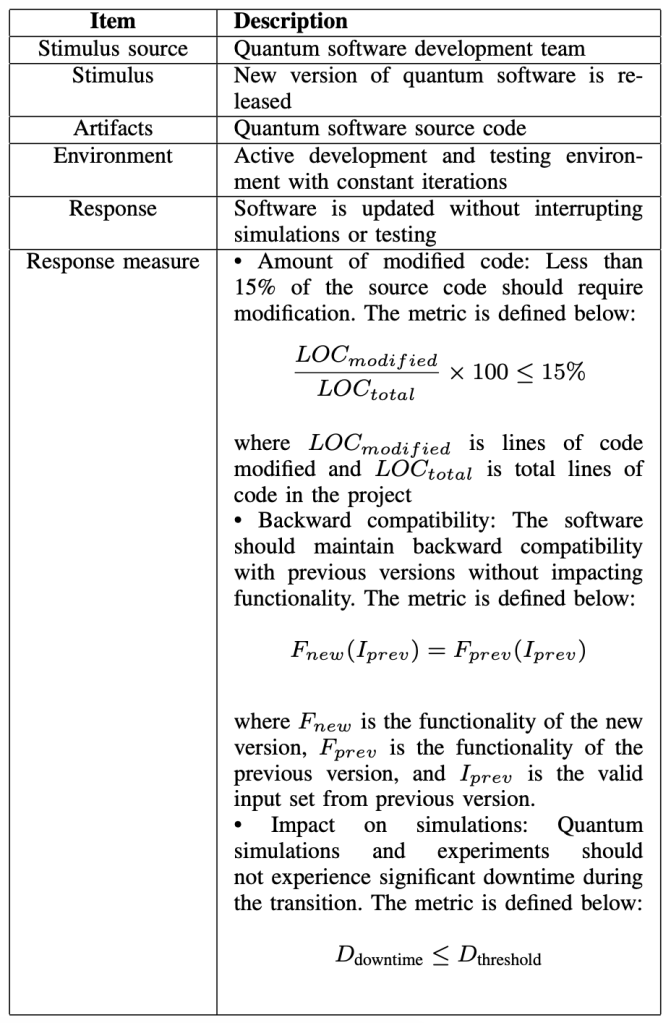
Quantum software engineering aims to establish methodologies, tools, and frameworks to support the development of functional and maintainable quantum applications. A critical aspect within this domain is the maintainability of quantum software, which pertains to the system’s capacity for modification, correction, or evolution over time. Modifiability is particularly significant as it encompasses mechanisms that enable software to be altered effectively and efficiently without introducing defects or compromising quality. Despite its importance, there has been limited discussion on addressing modifiability in quantum software. Moreover, there is little information on studies that translate maintainability concerns into specific modifiability scenarios. In this paper, we present our investigation about defining a modifiability scenario for quantum software, characterized by sources of stimuli, stimuli, software artifacts related to modifiability, environment, responses to the stimuli, and measures of those responses. We examined the release and version histories of 18 quantum software projects to extract data from each version. Preliminary findings outline the development of a concrete modifiability scenario for quantum software that facilitate the implementation of the defined responses within the modifiability scenario in quantum software.

This study will be published in IEEE Xplore and presented at CLEI 2025

Framework to Support Students in Defining DevOpsTechnology Stacks

DevOps is an approach to automated software development and deployment that combines development and operations, with the goal of improving collaboration between teams to optimize the software lifecycle processes, from planning and development to testing, deployment, and monitoring. Despite being an innovative approach, DevOps presents a significant challenge for students in understanding and implementing software development projects. This challenge includes understanding the problem to the solution abstraction that contemplates the design, implementation, and automation of the software development process. This study proposes and evaluates a methodological framework to support students in defining DevOps-oriented technology stacks.
The framework combines software architecture and software engineering practices that collectively provide a learning approach based on design decision-making and selection of technologies, frameworks, and tools. We evaluated the framework in two iterations of a capstone course, using a case study that considered the implementation of a DevOps stack on (i) a pre-existing system and (ii) a system from scratch. Results show that students who implemented a DevOps-oriented stack on systems developed from scratch were successful, but those who implemented it on a pre-existing system confronted challenges in configuration management and system flexibility. The proposed framework facilitates the pedagogical experience of implementing DevOps in software development projects, thus rendering it beneficial for students.

This study will be published in IEEE Xplore and presented at CLEI 2025